
Toddler Routines That Actually Work: A System for Real Life (Not Instagram)
- Nicole Fairbanks

- Feb 16
- 12 min read
Updated: Feb 16
Most advice about toddler routines falls into two unhelpful categories: the color-coded schedule that requires you to wake up at 5 AM with the energy of a lifestyle influencer, or the “just go with the flow” approach that sounds peaceful until you’re eating crackers for dinner at 9 PM because nobody planned anything.
I don't know about you, but neither of these methods work for me or my family, not for very long anyway! Sure, before I had my daughter I was a "just go with the flow" kind of gal- 100%. And, I'll admit, I tried this for awhile even after having Elliana, but about the time she started walking, I realized something had to change. What I was doing wouldnt't be sustainable long term. I started trying various methods I read about online- but I was making it more complicated than it needed to be.
What I have found to actually work (as is easy to implement), is building a flexible system, not a rigid toddler schedule - that creates predictable patterns your toddler recognizes without requiring you to perform miracles daily. This isn’t about perfection. It’s about reducing the number of decisions you make each day while keeping things calm enough that everyone survives until bedtime.
I am going to share the framework for building routines that hold up whether you work full-time, stay home, or cobble together some combination of both. I could give you our "base routine" and send you on your way, but the goal isn’t to follow someone else’s exact timeline. It’s to create a structure that fits your actual life and doesn’t collapse the first time someone gets sick or you have a rough week.
A quick definition (because it helps): a toddler routine is a predictable order of daily anchors (wake-up, meals, nap/quiet time, bedtime) with flexible timing.
Start Here (Do This Before You Try to “Fix Everything”)
If you do nothing else after reading this, do this:
Pick two anchors — morning and bedtime — and keep the order the same for 14 days.
Not the exact times. The order.
Choose a wake-up window (example: 6:30–7:30)
Choose a bedtime window (example: 7:00–7:45)
Write your morning order + bedtime order somewhere visible
Repeat it every day (yes, weekends)
Once that feels natural (and it's okay if it takes some time to get the hang of it), then you add meal spacing, cleanup rhythms, and margins. The routine sticks when you build it slowly. And trust me, it feels so good when the day comes that you realize you conquered it - less choas, more structure (but not the kind that makes you feel stuffy).
Why Most Toddler Routines Fail (And What to Do Instead)
Routines fail because they’re built on motivation instead of systems. They require you to feel motivated every single day, which is unrealistic when you’re operating on interrupted sleep and your toddler just smeared yogurt on the couch.
The routines that last are the ones that:
Happen in the same order, even if the timing shifts
Don’t require daily decision-making
Have built-in flexibility for bad days
Work with your energy level, not against it
Think of it like sourdough (bear with me). You can’t force dough to rise on your preferred timeline. You read the dough, adjust to the temperature, and work with what’s actually happening instead of what you wish was happening.
Toddler routines work the same way. The pattern stays consistent. The exact timing? Negotiable.
(And yes, reducing decisions helps. If you want the nerdy version (that I found to help my understanding of the concept), “decision fatigue” is a real studied concept: https://pmc.ncbi.nlm.nih.gov/articles/PMC6119549/)
The Three Parts of a Functional Toddler Routine
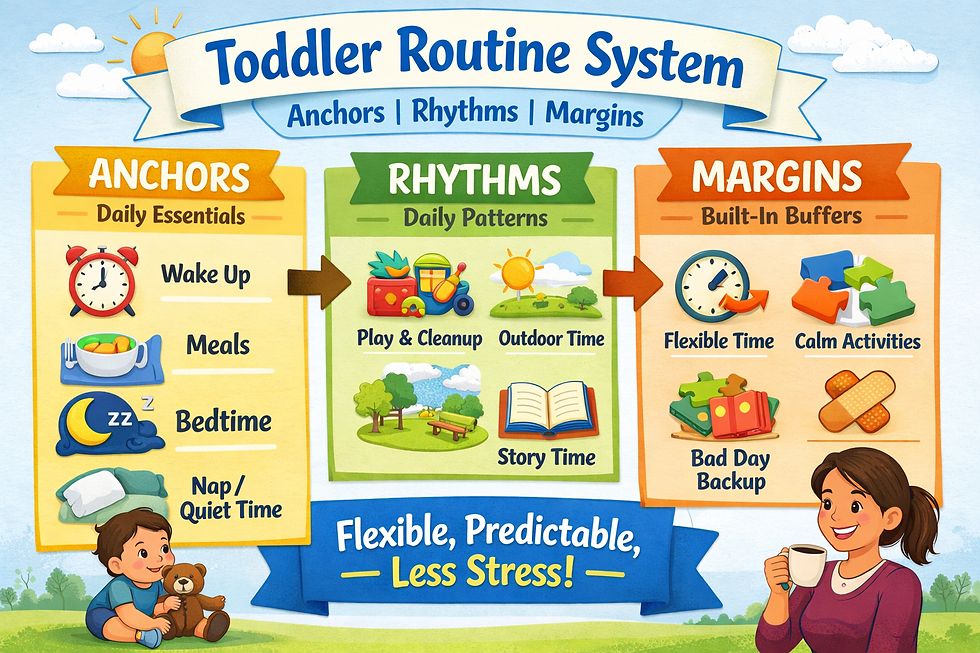
Every routine that actually works seems to have three primary components:
Anchors — Non-negotiable events that happen every day at roughly the same time (wake-up, meals, bedtime). These create the framework.
Rhythms — Predictable patterns between anchors that your toddler learns to expect (snack after park, bath before books, cleanup before lunch). These reduce resistance.
Margins — Buffer time built into the day so one meltdown doesn’t derail everything. These keep you sane.
Most people focus entirely on anchors — trying to nail exact times for everything — and skip the rhythms and margins. That’s why their routine works for three days and then mysteriously stops when the toddler refuses shoes or decides naptime is optional (it's been happening more frequently at our house lately!).
Building Your Base Routine (The Part That Stays the Same)
Start with what has to happen regardless of your schedule:
Wake-up window
Three meals
Nap or quiet time
Bedtime
Notice I said window, not time. A wake-up window of 6:30–7:30 AM is more sustainable than insisting on 7:00 sharp. Same with bedtime. A range of 7:00–7:45 PM gives you room to adjust based on how the day actually went.
For you working parents, these anchors might be tighter because you’re working around daycare or work schedules. And for stay-at-home parents, you have more flexibility with timing but still need the pattern to stay consistent. It can be rough somedays, but it is possible. The most important thing to remeber is that the sequence matters more than the clock.
The Morning Anchor (Toddler Morning Routine)
Mornings set the tone, which is annoying because I have never been a morning person, but it's true. A morning that starts chaotic usually stays chaotic. But “calm morning” doesn’t mean everyone’s dressed and eating a hot breakfast by 6 AM. I have learned it means something more along the lines of removing as many decisions as possible.
What this looks like: Toddler wakes → diaper/potty → get dressed → breakfast → cleanup
Clothes are laid out the night before (or you have a simple rotation system)
Breakfast is predetermined (more on this later)
Cleanup happens before the next activity starts
The order stays the same. The timing flexes. If your toddler wakes at 6:15 instead of 7:00, the pattern still holds. You’re not scrambling to figure out what comes next because they already know. It's good for everyone involved.
For working parents leaving the house: build in 15 extra minutes. Not because you’ll use it every day, but because toddlers have an uncanny ability to need a diaper change right as you’re walking out the door. I know one thing or another always slows us down as we are leaving... it's like an unspoken law or something.
For stay-at-home parents: resist the urge to “go with the flow” all morning. I catch myself doing this on occasion (I'm a work in progress), but it's always short-lived. Even if you’re not leaving the house, starting with a predictable pattern makes the rest of the day easier.
If you need an extra nudge, here is a helpful read on why routines matter: https://www.healthychildren.org/English/family-life/family-dynamics/Pages/The-Importance-of-Family-Routines.aspx
The Meal Anchors (Toddler Meals + Snack Rhythm)
Toddlers do better with consistent meal timing, even if what they actually eat is a mystery. Aim for meals at roughly the same time each day, with planned snacks in between.
Simple meal rhythm:
Breakfast: within an hour of waking
Morning snack: 2–2.5 hours after breakfast
Lunch: late morning/early afternoon
Afternoon snack: 2–3 hours after lunch
Dinner: early enough that bedtime isn’t rushed
The exact times shift based on your schedule, but the spacing stays similar. This prevents the constant “I’m hungry” / “You just ate” battle and keeps blood sugar steady, which reduces meltdowns. I don't know about you but anything to reduce the chance of a meltdown is worth trying in my book.
So, here’s the part nobody mentions: you don’t have to cook elaborate meals. Toddlers need fuel, not culinary experiences ,despite what some modern toddler recipe books may imply. Rotation meals, the same 5-7 options on repeat, reduce decision fatigue and make grocery shopping easier. They’ll eat the same thing 47 times in a row anyway. Literally.
If want a realistic baseline for toddler portions/food groups, I've found this to be really helpful: https://www.healthychildren.org/English/ages-stages/toddler/nutrition/Pages/Sample-One-Day-Menu-for-a-Two-Year-Old.aspx
The Nap or Quiet Time Anchor (Toddler Nap Routine / Quiet Time)
Even if your toddler stops napping (devastating, I know), keeping a midday quiet time is worth it. This is the reset point for both of you and it definetly helps keep the "vibe" calm and balanced.
What works:
Same time window every day (usually after lunch)
Same location (crib, bed, or designated quiet spot)
Same wind-down routine (books, dim lights, sound machine)
1–2 hours minimum, whether they sleep or not
If they’ve dropped the nap but still need downtime, quiet time in their room with books or quiet toys gives you both a break. And on the days they do fall asleep? Bonus.
For working parents using daycare: your toddler’s nap happens there, so your weekend rhythm should mirror it as closely as possible. Same general timing, same wind-down approach. Consistency across settings makes everything easier.
For those of you who are constantly troubleshooting overtired chaos, these sleep-duration ranges are a helpful reference: https://www.cdc.gov/sleep/about/index.html
The Bedtime Anchor (Toddler Bedtime Routine)

Bedtime routines get the most attention, and for good reason — they work. But they only work if you do them every single night, even when you’re tired and it would be easier to skip steps.
Standard bedtime rhythm: Dinner → bath or wash-up → pajamas → brush teeth → books → bed
Start early enough that you’re not rushing. Keep it boring (this is a feature, not a bug). Same order, every time. Consistency is the key here, always.
The routine signals sleep is coming, which helps toddlers wind down. Skipping steps or changing the order confuses them and usually results in a longer, more difficult bedtime.
Total time: 30–45 minutes, depending on your toddler’s cooperation level and whether they’ve decided tonight’s the night to debate every single step.
Adding Rhythms Between the Anchors
Once your anchors are solid, you build rhythms between them. These are the predictable patterns that fill the in-between time and reduce the number of battles you fight.
Example rhythms:
After breakfast → get dressed, brush teeth
Before lunch → cleanup/reset main play area
After nap → snack, then outdoor time or activity
Before dinner → another cleanup checkpoint
After bath → calm activities only (no chase games at 7 PM)
These don’t require strict timing, just consistent order. Your toddler learns what comes next, which reduces resistance. They know cleanup happens before lunch, so they’re less likely to fight it (still likely, just less likely).
The cleanup rhythm is particularly worth establishing early. Teaching toddlers that one activity ends before the next begins — even if “cleanup” just means tossing toys in a bin — sets a pattern that pays off for years. I
One of the earliest routines I built with Elliana was a simple bath “closeout.” As soon as she could sit independently, we did the same sequence: play → wash → drain the tub → sing a silly cleanup song while putting away the toys.
The payoff came surprisingly fast. She began copying me and picking up alongside me, and that small, predictable bath reset became a pattern she recognized elsewhere. It wasn’t about the toys—it was about practicing the rhythm of finishing.
The Margin Problem (And How to Fix It)
Here’s where most routines break: there’s no buffer time. Everything’s scheduled back-to-back, so one delay cascades into chaos. This where you have to learn to be flexible.
Build margins by:
Padding transition times (10 minutes to get shoes on, even if it takes 3)
Accepting that some activities will take longer than planned
Having a few “filler” activities ready (books, simple toys, a snack)
Not scheduling anything immediately after nap that has to happen on time
Margins aren’t wasted time. They’re insurance against meltdowns, surprise diapers, and toddlers who suddenly refuse to cooperate. A routine with margins survives real life. A routine without them falls apart. Maybe not right away, but they will... take my word.
Routines for Working Parents vs. Stay-at-Home Parents
The basic framework stays the same, but how you execute it differs based on your schedule.
Working Parents (Out of the House)
Your mornings and evenings are tighter because you’re working around external schedules. The midday is largely handled by daycare or caregivers.
What to prioritize:
Extremely consistent morning routine (seriously, don’t deviate)
Prepped everything the night before (clothes, bags, breakfast components)
Simple, fast meals that still hit nutritional basics
Bedtime routine that reconnects you with your toddler
Weekend routines that stay close to weekday patterns
The hardest part is maintaining consistency when you’re exhausted. Weekends especially — it’s tempting to let everything slide, but toddlers don’t understand “it’s Saturday.” Keeping the basic rhythm (similar wake time, meals, nap, bedtime) makes Mondays easier.
Stay-at-Home Parents
You have more flexibility with timing but need more structure than you think. Without external schedules forcing the routine, it’s easy to drift into chaos.
What to prioritize:
Set wake-up and meal times even though you could be flexible
Built-in activities that get you both out of the house (park, errands, library)
Structured afternoon so you don’t hit 4 PM with no plan
Same bedtime routine as working parents (consistency matters just as much)
Designated “work” time for yourself during nap/quiet time
The trap is thinking flexibility equals no routine. But toddlers thrive on predictability, and you’ll have more energy when you’re not making 47 decisions before noon.

Making It Work on Bad Days (Minimum Viable Toddler Routine)
Routines built only for good days aren’t routines — they’re fantasies. A functional system has a scaled-back version for when things go sideways. Because if we are being completely honest - things go sideways A LOT. And that's okay!
Minimum viable routine:
Feed them something reasonably nutritious at roughly normal times
Get them outside for at least 20 minutes (even if it’s just the backyard)
Maintain the bedtime routine no matter what else falls apart
Lower your standards for everything else
Some days, breakfast is a Go & Grow protein drink in the car. Some days, you skip the bath. Some days, the house stays a disaster. The routine doesn’t require perfection - it just requires hitting the most important anchors so tomorrow isn’t more difficult then necessary.
What to Adjust as They Grow
Toddlerhood covers a huge developmental range (roughly 12 months to 3+ years), so your routine needs to evolve. You should find that once you find what workd for your family, the changes happen almost naturally.
Common shifts:
Dropping from two naps to one (12–18 months usually)
Later bedtime as they drop the afternoon nap (around age 3–4)
More involved cleanup and self-care tasks as skills develop
Longer attention span for activities and books
When you make changes, do them gradually. Shift naptime by 15 minutes every few days rather than jumping from 1 PM to 3 PM overnight. Add one new step to the routine at a time. Toddlers handle gradual change better than sudden overhauls.
My transition with Elliana going from 2 naps to 1 nap took almost a month. At first I was stressing over it, calling my other mom friends asking them what their kid(s) did for naps at her age . Haha. She wasn't ready to go to just one nap until she was 18 months old, but it honestly didn't matter. Every child is different. And in retrospect... I enjoyed having the extra "me" time to get things done around the house.
The Products That Actually Help
You don’t need a color-coded chart or fancy organizational system. But here are a few practical items that have proven to make routines easier to maintain in our home:
Visual schedule cards — Simple pictures showing the routine order (getting dressed, breakfast, teeth, etc.). Toddlers can follow along even before they can read.
Meal prep containers — Prepping breakfast and snack components once or twice a week reduces daily decisions.
Divided plates — Makes balanced meals faster to assemble and easier for toddlers to manage.
Bedside clock with wake-up light — Teaches toddlers when it’s okay to get up (this is a long game, but it works eventually).
Large, easy-access toy bins — Cleanup is faster when “putting away” just means tossing things in a bin.
Notice none of these are expensive or elaborate. Routines don’t fail because you lack the right products. They fail because the system itself is unsustainable.
The Four Supporting Systems
This framework works best when supported by four specific systems, each addressing a different part of your day. These aren’t separate routines; they're each pieces of the larger system in motion.
I cover each of these in detail in other posts, but here’s the overview:
Morning Launch System — The exact sequence that gets everyone fed, dressed, and ready without screaming. This includes evening prep, breakfast rotation options, and timeline adjustments for different schedules.→ Internal link: [Morning Launch System] (replace with your Wix URL, suggested slug: /morning-launch-system)
Meal and Snack Rotation System — A sustainable approach to feeding toddlers that removes daily decision-making. Simple rotations, prep strategies, and how to handle the inevitable food refusals.→ Internal link: [Meal & Snack Rotation System] (suggested slug: /meal-snack-rotation-system)
Activity and Energy Management System — How to structure the hours between meals so you’re not constantly scrambling for “what’s next.” Includes high-energy vs. low-energy activity balance, outdoor time, and rainy day backup plans.→ Internal link: [Activity & Energy Management System] (suggested slug: /activity-energy-management-system)
Evening Reset and Bedtime System — The step-by-step approach to winding down the day, including dinner timing, cleanup routines, bath logistics, and the actual bedtime sequence that works.→ Internal link: [Evening Reset & Bedtime System] (suggested slug: /evening-reset-bedtime-system)
Each system plugs into the overall framework, giving you the specific tactics to make the pattern hold. It sounds fancier than it is! They will all naturally flow together, but it's easier if you have a better understanding of them individually first.
Start Here
Don’t try to implement everything at once. Start with the two anchors that affect your day most: morning and bedtime. Get those consistent for two weeks before adding anything else.
Pick your wake-up window. Decide on your bedtime routine. Do them the same way every day, even on weekends. Once those feel automatic, add the meal rhythms. Then the cleanup patterns. Then the margins.
Building a routine slowly is what will make it acually stick. It really will. Overhauling everything at once means you’ll be back to chaos in a week. And you don't have the time or the energy for that!
Your routine won’t look like anyone else’s, and that’s the point. The framework is universal. The execution is personal. What matters is that it reduces daily decisions, creates predictability for your toddler, and doesn’t require you to be superhuman to maintain it.
Because the goal was never perfection. It was a home that runs a little smoother and a day that feels a little less chaotic. The time it takes to do these things is affordable. The payoff? Well, it will absolutely hold endless value to you and your toddler, saving much needed time and energy.


Comments